Click here
 for an animation that explains how restriction enzymes cut DNA.
Still confused? Think of it this way: our bodies naturally produce restriction enzymes. We call them digestive enzymes, like amylase, trypsin, pepsin, protease, lipase, etc. These enzymes are not effective to cut DNA for genetic engineering purposes because they cut DNA randomly. That's why scientists rely on restriction enzymes produced by bacteria. These enzymes can cut DNA at precise locations.
A restriction enzyme recognizes and cuts DNA only at a particular sequence of nucleotides. For example, the bacterium Hemophilus aegypticus produces an enzyme named HaeIII that cuts DNA wherever it encounters the sequence
5'GGCC3'
3'CCGG5'
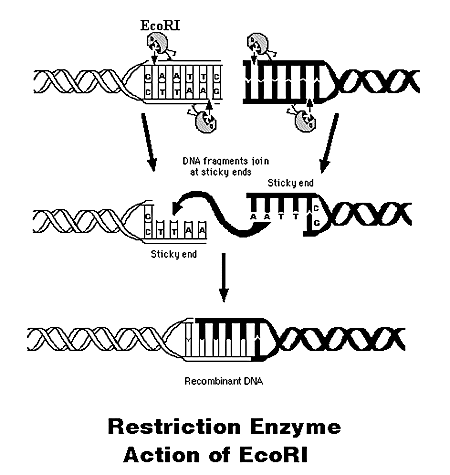
The cut is made between the adjacent G and C. HaeIII cuts straight across the double helix producing "blunt" ends. However, many restriction enzymes cut in an offset manner (like HIND III that we used during the gene splicing simulation). The ends of the cut have an overhanging piece of single-stranded DNA. These are called "sticky ends" because they are able to form base pairs with any DNA molecule that contains the complementary sticky end. Any other source of DNA treated with the same enzyme will produce the same cuts.
Mixed together, these molecules can join with each other by base pairing between their sticky ends. The two DNA molecules can be joined by another enzyme, DNA ligase. The result is a molecule of
recombinant DNA (rDNA).
The ability to produce recombinant DNA molecules has allowed geneticists to produce human insulin (for
diabetics), human factor VIII (for males with
hemophilia A), and other proteins used in
human therapy all were made possible by recombinant DNA.
 Click here to click and clone Mimi. This is the same animation we used in class.
 Click here for an animation that explains how restriction enzymes cut DNA.
 Click here to practice your selective breeding skills. Can you create the largest crop of corn? Try it!
 Click here to view an animation that explains how mutations occur in your DNA.
  Happy Snow Day everyone! Stay warm and enjoy your day off:)